Overview
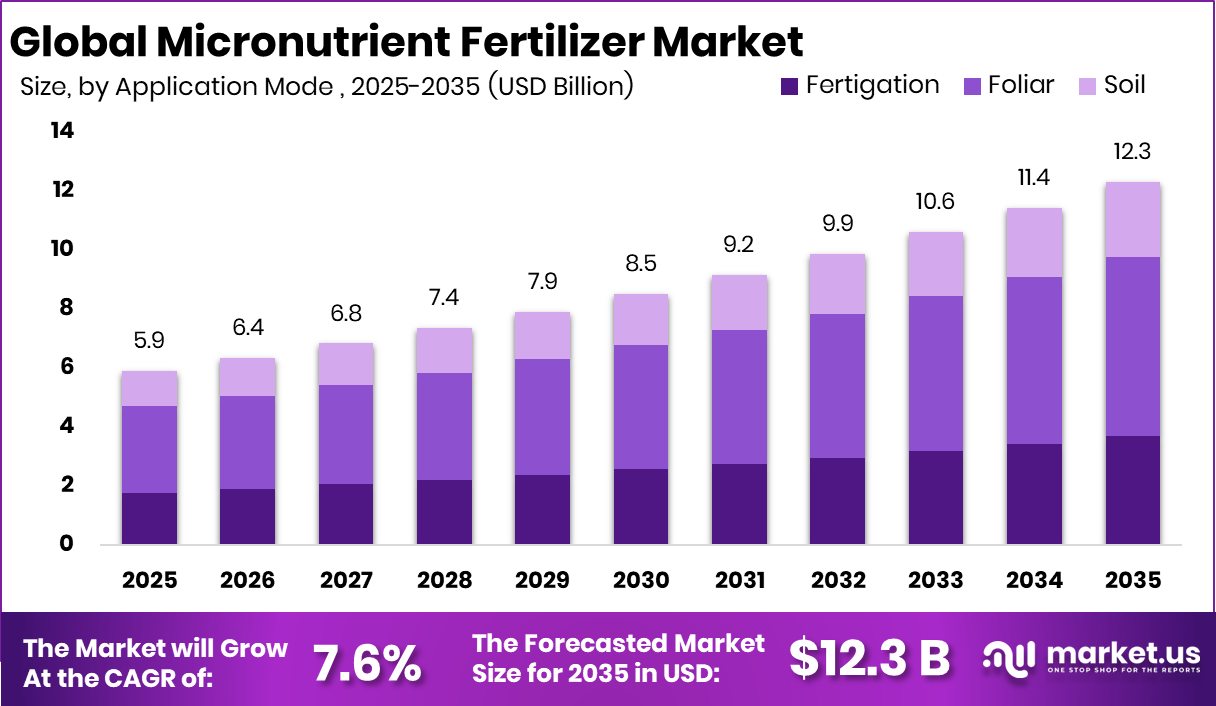
Micronutrient Fertilizer Market development is closely linked to the growing emphasis on efficient nutrient management in agriculture. The market is projected to nearly double from USD 5.9 billion in 2025 to USD 12.3 billion by 2035. Supported by a 7.6% CAGR, growth reflects rising demand for fertilizers that supply critical trace nutrients required for crop development. Farmers are increasingly integrating micronutrient products into fertilization programs to enhance yields and maintain soil fertility over the long term.
 Click to explore more: https://market.us/reports/food-and-beverages/
Key Takeaways
- The Global Micronutrient Fertilizer Market is projected to reach USD 12.3 billion by 2035, rising from USD 5.9 billion in 2025.
- The market is expected to expand at a CAGR of 7.6% during 2026–2035.
- Zinc dominated the product segment with a 38.4% market share.
- Foliar application accounted for 49.5% of the application mode segment.
- Field crops represented 51.7% of the total market share by crop type.
- Asia Pacific held the leading regional position with 39.1% share, valued at USD 2.3 billion.
By Product Analysis
In 2025, zinc held a dominant 38.4% share of the market. Zinc plays a crucial role in enzyme activation, protein synthesis, and overall plant development. Its widespread use is driven by the increasing prevalence of zinc-deficient soils, particularly in regions experiencing intensive agricultural production. Demand has been further supported by the large-scale cultivation of cereals, grains, and oilseeds, which respond positively to zinc supplementation. Growing awareness regarding balanced nutrient management and soil health initiatives has also strengthened the adoption of zinc-based fertilizers worldwide.
By Application Mode Analysis
In 2025, foliar application captured 49.5% of the market share, making it the leading application method. Foliar feeding enables direct nutrient absorption through plant leaves, allowing crops to quickly correct micronutrient deficiencies during critical growth stages. Farmers favor this method because it requires smaller fertilizer quantities while delivering faster and more efficient results than many traditional soil-based applications. The increasing use of precision agriculture technologies and advanced spraying systems has further contributed to the popularity of foliar micronutrient fertilizers.
By Crop Type Analysis
Field crops accounted for 51.7% of the Micronutrient Fertilizer Market in 2025, making them the largest crop segment. Major crops such as wheat, rice, maize, and barley require balanced micronutrient nutrition to maximize productivity and maintain crop quality. Continuous cultivation has reduced natural soil nutrient reserves, increasing the importance of micronutrient supplementation. As global food demand continues to rise, farmers are increasingly incorporating micronutrient fertilizers into nutrient management programs to support crop health and improve resilience against environmental stress.
Key Market Segments
By Product
- Boron
- Copper
- Iron
- Manganese
- Molybdenum
- Zinc
- Others
By Application Mode
- Fertigation
- Foliar
- Soil
By Crop Type
- Field Crops
- Horticultural Crops
- Turf and Ornamental
Driving Factors
Rising Soil Micronutrient Deficiency Globally
Increasing micronutrient deficiency in agricultural soils is a major factor driving market growth. Continuous cultivation, intensive farming, and unbalanced fertilizer application have reduced the availability of essential trace nutrients. As a result, farmers are increasingly adopting micronutrient fertilizers to restore soil fertility and maintain stable crop yields. Technological developments and financial support for advanced agricultural solutions are also encouraging improved nutrient management practices, contributing to greater adoption of micronutrient fertilizers worldwide.
Restraining Factors
High Cost of Micronutrient Fertilizers
The relatively high cost of micronutrient fertilizers remains a significant challenge, particularly for small and medium-scale farmers. Compared with conventional fertilizers, these products often involve higher formulation, production, and application expenses. In many cost-sensitive agricultural regions, this can limit adoption despite the long-term agronomic benefits. While research and innovation continue to support improvements in nutrient efficiency and crop productivity, affordability remains an important market constraint.
Growth Opportunity
Growing Adoption of Precision Farming
The increasing adoption of precision farming presents a major opportunity for market expansion. Precision agriculture technologies enable farmers to apply nutrients based on specific soil conditions, crop requirements, and field variability. This targeted approach improves fertilizer efficiency, reduces waste, and minimizes environmental impact. Micronutrient fertilizers play a vital role in these systems by delivering precise nutrient supplementation where it is most needed. Continued investment in advanced agricultural research, digital farming technologies, and nutrient management solutions is expected to create favorable conditions for broader market adoption.